Knowing the exact 2015 f150 lug nut torque specification keeps your pickup wheels locked safely against the hub. Heavy half-ton trucks place massive rotational and towing loads on their wheel studs during highway driving. Guessing at fastener tightness with a basic hand wrench often leads to warped brake rotors or loose wheels. This guide provides the official 2015 f150 lug nut torque alongside every Ford truck rating from 2011 through 2026. You will also learn how to handle swollen factory lug caps, thread pitch differences, and six-lug star patterns.
If you are currently stranded on the roadside with a puncture, read our complete guide on how to change a tire safely before lifting your truck.
Key Takeaways
- The official 2015 f150 lug nut torque specification is 150 ft lbs (204 Nm) on clean, dry studs.
- All Ford F150 trucks built from 2004 through 2026 share the exact same 150 ft lbs (204 Nm) torque rating.
- Ford changed the wheel stud thread pitch in 2015 from coarse M14 x 2.0 to fine M14 x 1.5.
- Standard factory lug nuts require a 21 mm (13/16 inch) deep six-point socket for removal and installation.
- Swollen two-piece factory chrome lug nuts often require a 21.5 mm or 22 mm (7/8 inch) socket to remove.
- Always tighten six-lug pickup wheels in a crisscross star sequence while the truck rests on the ground.
The “Before You Start” Checklist
Gather these essential tools and supplies before removing and tightening lug nuts on your pickup truck:
- Calibrated click-type or digital torque wrench: Capable of measuring at least 150 to 250 ft lbs (204 to 339 Nm).
- 1/2 inch drive breaker bar: At least 24 inches (60 cm) long for loosening tight factory lug nuts safely.
- 21 mm (13/16 inch) deep six-point socket: Thin-walled chromoly socket for standard undamaged factory lug nuts.
- 21.5 mm and 22 mm (7/8 inch) sockets: Essential backup sockets if your two-piece factory lug caps have swollen.
- 3 inch (7.5 cm) socket extension bar: Keeps your torque wrench handle clear of the truck fender flare.
- Wire bristle brush and clean microfiber cloth: Used to scrub rust flakes and grit off the brake hub face.
- Wheel chocks and heavy-duty jack stands: Rated for at least 3 tons (2,720 kg) to support pickup truck weight.
- One-piece solid carbon steel replacement lug nuts: Recommended if your original capped nuts show distortion.
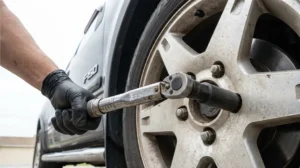
What Is the Official 2015 F150 Lug Nut Torque Specification?
The official 2015 f150 lug nut torque specification is 150 pound feet (150 ft lbs), which equals 204 Newton meters (204 Nm). This factory specification applies to both original equipment aluminum alloy wheels and stamped steel rims across all 2015 trim levels. Always apply this torque to clean, dry threads without any oil or grease.
When Ford introduced the thirteenth generation aluminum-body truck in 2015, engineers kept the heavy-duty 14 mm wheel stud diameter. According to the Ford Owner’s Manual Technical Specifications, tightening each M14 x 1.5 fastener to 150 ft lbs (204 Nm) generates the exact clamping load required for towing and hauling. You can always verify your trim details inside your car owners manual before starting work.
Whether you drive a regular cab XL work truck, a Lariat EcoBoost, or a King Ranch 5.0L V8, the 2015 f150 lug nut torque never changes. The same 150 ft lbs (204 Nm) rule also covers every model year surrounding 2015. Drivers searching for the 2016 f150 lug nut torque, the 2018 ford f150 lug nut torque, the 2019 f150 lug nut torque, or the 2020 f150 lug nut torque will use this exact same number. Older twelfth-generation pickups, including the 2011 f150 lug nut torque, the 2013 f150 lug nut torque, and the 2014 f150 lug nut torque, also require 150 ft lbs (204 Nm).
Ford F150 Lug Nut Torque Chart by Year (1997 to 2026)
Ford F150 lug nut torque specifications depend on the wheel stud diameter installed during your truck manufacturing year. Models built from 1997 to 2003 with 12 mm studs require 100 ft lbs (135 Nm). Every Ford F150 built from 2004 through 2026 uses 14 mm studs and requires 150 ft lbs (204 Nm).
While the torque rating has remained consistent at 150 ft lbs (204 Nm) since 2004, the thread pitch changed right at the 2015 model year. Buying replacement lug nuts from an older 2014 truck and forcing them onto a 2015 hub will strip your steel wheel studs immediately. Review the complete generation and year specification chart below, cross-referenced with data from Late Model Restoration, before buying hardware or setting your wrench.
Complete Ford F150 Wheel Torque & Thread Pitch Reference Table
| Model Year / Keyword Target | Truck Generation | Lug Nut Torque (Imperial) | Lug Nut Torque (Metric) | Stud Thread Size | Hex Socket Size | Bolt Pattern |
|---|---|---|---|---|---|---|
| 1997 to 1999 F150 | 10th Gen (Early) | 100 ft lbs | 135 Nm | M12 x 1.75 | 19 mm (3/4 in) | 5 x 135 mm |
| 2000 to 2003 F150 | 10th Gen (Late) | 100 ft lbs (12mm) / 150 ft lbs (14mm) | 135 Nm / 204 Nm | M12 x 1.75 or M14 x 2.0 | 19 mm or 21 mm | 5 x 135 mm |
| 2004 to 2008 F150 | 11th Gen | 150 ft lbs | 204 Nm | M14 x 2.0 (Coarse) | 21 mm (13/16 in) | 6 x 135 mm |
| 2011 f150 lug nut torque | 12th Gen (2009 to 2012) | 150 ft lbs | 204 Nm | M14 x 2.0 (Coarse) | 21 mm (13/16 in) | 6 x 135 mm |
| 2013 f150 lug nut torque | 12th Gen | 150 ft lbs | 204 Nm | M14 x 2.0 (Coarse) | 21 mm (13/16 in) | 6 x 135 mm |
| 2014 f150 lug nut torque | 12th Gen | 150 ft lbs | 204 Nm | M14 x 2.0 (Coarse) | 21 mm (13/16 in) | 6 x 135 mm |
| 2015 f150 lug nut torque | 13th Gen | 150 ft lbs | 204 Nm | M14 x 1.5 (Fine) | 21 mm (13/16 in) | 6 x 135 mm |
| 2016 f150 lug nut torque | 13th Gen (2016 to 2017) | 150 ft lbs | 204 Nm | M14 x 1.5 (Fine) | 21 mm (13/16 in) | 6 x 135 mm |
| 2018 ford f150 lug nut torque | 13th Gen Facelift | 150 ft lbs | 204 Nm | M14 x 1.5 (Fine) | 21 mm (13/16 in) | 6 x 135 mm |
| 2019 f150 lug nut torque | 13th Gen Facelift | 150 ft lbs | 204 Nm | M14 x 1.5 (Fine) | 21 mm (13/16 in) | 6 x 135 mm |
| 2020 f150 lug nut torque | 13th Gen Facelift | 150 ft lbs | 204 Nm | M14 x 1.5 (Fine) | 21 mm (13/16 in) | 6 x 135 mm |
| 2021 to 2026 F150 (All Trims) | 14th Gen | 150 ft lbs | 204 Nm | M14 x 1.5 (Fine) | 21 mm (13/16 in) | 6 x 135 mm |
| 2010 to 2026 F150 Raptor | Gen 1, Gen 2, Gen 3 | 150 ft lbs | 204 Nm | M14 x 2.0 (10-14) / M14 x 1.5 (17+) | 21 mm (13/16 in) | 6 x 135 mm |
Why Does the 2015 F150 Require 150 Ft Lbs of Clamping Force?
A 2015 Ford F150 requires 150 ft lbs (204 Nm) of torque to stretch the 14 mm steel wheel studs into their elastic clamping zone. That high tension locks the wheel hub and brake rotor together so heavy payload forces cannot shear the studs. Proper stud tension also stops the nuts from vibrating loose.
Understanding the mechanical reason behind the 2015 f150 lug nut torque prevents costly wheel hub damage. Passenger sedans typically weigh 3,000 to 3,800 pounds (1,360 to 1,720 kg) and use thinner 12 mm wheel studs torqued to 80 or 100 ft lbs (108 to 135 Nm). By comparison, a full-size F150 pickup weighs 4,500 to 5,700 pounds (2,040 to 2,585 kg) empty and can tow over 10,000 pounds (4,535 kg). Similarly, other half-ton pickups require high clamping force, which we cover in our 2015 ram 1500 lug nut torque guide.
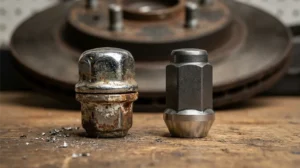
The Physics of Wheel Stud Stretch and Clamping Load
Threaded steel wheel studs act like stiff metal springs when you tighten a lug nut. Turning the torque wrench to 150 ft lbs (204 Nm) stretches the 14 mm steel stud microscopically along its length. That controlled elastic tension pulls the wheel mounting pad tightly against the flat face of the brake rotor. Friction between the compressed wheel face and the hub carries the vertical weight of the truck. If you under-tighten the lug nuts to 90 ft lbs (122 Nm), the clamping friction drops too low. Every time the wheel rotates under load, the rim shifts slightly against the studs and elongates the bolt holes.
Why Ford Switched from M14 x 2.0 to M14 x 1.5 in 2015
Between 2004 and 2014, twelfth-generation trucks used M14 x 2.0 studs, meaning the thread peaks sit 2.0 mm apart. Starting with the 2015 model year, Ford redesigned the wheel hubs with M14 x 1.5 fine-pitch threads. Fine threads have a shallower helix angle and more thread contact area per inch of stud length. That finer thread pitch resists backing out under heavy off-road vibration and delivers more consistent clamping force at the 2015 f150 lug nut torque setting of 150 ft lbs (204 Nm).
The Root Cause of Swollen Ford Two-Piece Lug Nuts
If your 21 mm socket will not slide onto your lug nuts, you are dealing with Ford’s notorious two-piece lug nut design. Instead of machining the lug nut from one solid piece of chrome-plated steel, the factory uses a plain carbon steel inner core. A thin stainless steel or chrome decorative cap is crimped over that steel core. Over time, road salt, wash water, and moisture seep into the tiny gap between the inner steel nut and the outer cap.
When steel rusts, iron oxide expands up to six times its original volume. That powdery white and red corrosion pushes the thin outer metal jacket outward like a balloon. Mechanics using high-speed pneumatic wrenches also twist the thin metal jacket, rounding off the hex corners. Suddenly, your standard 21 mm lug wrench from your auto emergency tool kit can no longer fit over the swollen 21.5 mm or 22 mm cap.
Step-by-Step Methods for Tightening and Removing F150 Lug Nuts by Severity
Your approach to removing and tightening lug nuts depends on whether your hardware is clean, swollen, or rusted solid. Standard maintenance requires a two-pass star tightening sequence with a calibrated torque wrench. Swollen or seized lug nuts require half-size extraction sockets and careful hub preparation before applying the 2015 f150 lug nut torque.
Below are two complete numbered procedures covering clean installation as well as moderate and severe extraction scenarios.
Process 1: How to Torque 2015 F150 Lug Nuts Correctly (Mild / Standard Case)
Follow this two-stage tightening procedure whenever mounting wheels in good condition:
- Clean the Wheel Studs and Hub Face: Scrub any flaky rust or dried mud off the steel wheel studs and rotor mounting pad using a wire brush. Wipe the threads dry with a clean cloth so no grit interferes with the torque reading.
- Thread All Six Lug Nuts by Hand: Lift the wheel onto the hub and thread each M14 x 1.5 lug nut clockwise using your fingers. Hand-threading at least five full turns ensures the fine threads do not cross-thread.
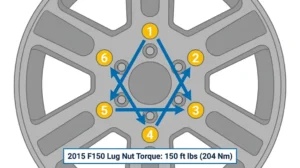
- Snug the Nuts in a 6-Lug Star Pattern: While the tire is still slightly off the ground, snug the nuts lightly to 30 ft lbs (40 Nm). Start at the top nut (1), cross straight down to the bottom nut (4), move to top-right (2), cross to bottom-left (5), move to bottom-right (3), and finish at top-left (6).
- Lower the Truck Until the Tire Touches Pavement: Lower your floor jack or scissor jack until the rubber tire supports the full corner weight of the pickup. Keep the parking brake engaged so the hub cannot rotate.
- Perform Pass One at 75 Ft Lbs (102 Nm): Set your calibrated torque wrench to 75 ft lbs (102 Nm), which is half of the final 2015 f150 lug nut torque. Tighten all six lug nuts in the exact 1-4-2-5-3-6 star sequence until the wrench clicks on each nut.
- Perform Final Pass Two at 150 Ft Lbs (204 Nm): Adjust your torque wrench dial to 150 ft lbs (204 Nm). Repeat the 1-4-2-5-3-6 star pattern with a smooth, steady pull until you hear and feel a single crisp click on every lug nut.
Process 2: Removing Swollen or Seized F150 Lug Nuts (Moderate & Severe Cases)
If your factory two-piece lug nuts are swollen or corroded onto the studs, follow these steps to remove them without damaging your alloy wheels:
- Test Fit a 21.5 mm Half-Size Socket (Moderate Swelling): Do not force a standard 21 mm socket with a hammer if it gets stuck halfway down the nut. Slide a specialized 21.5 mm or 22 mm (7/8 inch) six-point thin-wall socket over the swollen chrome cap.
- Break Resistance with a Manual Breaker Bar: Attach a 24 inch (60 cm) 1/2 inch drive breaker bar to the socket. Pull counterclockwise with steady, even force rather than using a vibrating impact wrench that spins the outer cap free of the inner core.
- Peel Off a Spinning Outer Chrome Cap (Severe Cap Failure): If the outer tin shell spins freely without turning the inner steel nut, tap a flathead chisel into the center seam of the cap. Pry the thin chrome wrapper off the nut with pliers to expose the raw steel core underneath.
- Fit an 18 mm or 19 mm Socket Onto the Inner Core: Once the outer beauty cap is removed, the exposed inner steel nut measures approximately 18.5 mm to 19 mm (3/4 inch). Tap a six-point 19 mm socket firmly onto the inner core and unscrew the nut with your breaker bar.
- Treat Rusted Studs and Install One-Piece Lugs: If the stud threads squeak or bind from rust, apply two drops of penetrating fluid to loosen the nut. Once removed, clean all penetrating oil off the stud with brake cleaner, dry thoroughly, and install solid one-piece steel lug nuts torqued to 150 ft lbs (204 Nm).
How Does Lug Nut Torque Vary by Wheel Material and Fastener Type?
Wheel material and lug nut construction determine which seat style and socket wall thickness you must use on a Ford F150. Factory aluminum wheels, steel spare rims, aftermarket custom wheels, and Raptor beadlock rings all require specific seating geometry. However, the main hub stud torque remains 150 ft lbs (204 Nm) across all wheel materials.
One of the biggest debates on truck forums involves whether aftermarket wheels or aftermarket lug nuts require a lower torque setting. According to Discount Tire’s Wheel Torque Guidelines, wheel fastener torque is dictated primarily by the diameter and thread pitch of the vehicle wheel stud, along with the wheel seat material.
Factory Aluminum Alloy Wheels vs. Heavy-Duty Steel Rims
Most 2015 to 2026 F150 trims come equipped with painted, machined, or PVD chrome aluminum alloy wheels. Factory Ford lug nuts feature a wide 60-degree conical bulge seat designed specifically to spread the 150 ft lbs (204 Nm) clamping load across the softer aluminum lug hole. If you use a small, narrow acorn nut intended for a steel car rim on a factory F150 aluminum wheel, the narrow nut will dig into the aluminum taper and gouge the metal. Always verify that replacement lug nuts have a wide OEM-style bulge conical seat before tightening to the 2015 f150 lug nut torque spec.
Resolving the Gorilla 95 Ft Lbs vs. OEM 150 Ft Lbs Debate
Many F150 owners upgrade their swollen factory two-piece nuts to solid one-piece forged steel lug nuts from brands like Gorilla Automotive or McGard. When owners open the Gorilla packaging, they often notice a printed generic chart listing 85 to 95 ft lbs (115 to 129 Nm) for 14 mm x 1.5 lug nuts. That generic insert causes widespread confusion.
Here is the technical truth: generic aftermarket packaging charts print conservative passenger-car values for standard 14 mm studs found on sedans and crossovers. Gorilla’s official engineering guidance states that you must always follow the vehicle manufacturer OEM torque specification first, and only use the generic box chart if no OEM spec exists. Because solid one-piece cold-forged carbon steel lug nuts are stronger than Ford’s two-piece factory nuts, they easily handle the full 2015 f150 lug nut torque of 150 ft lbs (204 Nm).
Aftermarket Spline-Drive Wheels and Raptor Beadlock Rings
- Aftermarket Custom Wheels (Fuel, Method, Moto Metal): Custom aftermarket truck wheels usually have narrow recessed lug holes that cannot fit a wide 21 mm factory socket. These wheels require small-diameter 60-degree conical spline-drive lug nuts and a special thin-wall spline key adapter. Torque these 14 mm spline lug nuts to 150 ft lbs (204 Nm) unless the wheel manufacturer explicitly stamps a lower structural limit on the rim.
- Ford F150 Raptor Beadlock Wheel Rings: If your F150 Raptor has factory beadlock-capable wheels, the six main wheel hub lug nuts still torque to 150 ft lbs (204 Nm). However, the 24 outer perimeter bolts that clamp the functional beadlock ring onto the tire bead require a much lighter three-stage sequence: Pass 1 at 11 ft lbs (15 Nm), Pass 2 at 26 ft lbs (35 Nm), and Pass 3 at 48 ft lbs (65 Nm).
What NOT to Do When Torquing Ford F150 Lug Nuts
Never use an uncalibrated pneumatic or cordless impact wrench to tighten Ford F150 lug nuts to their final position. Avoid applying anti-seize, oil, or grease to the wheel stud threads, and never use a twelve-point socket on two-piece factory lugs. These common errors ruin wheel studs and deform lug caps.
Even seasoned home mechanics make avoidable mistakes when working with high-torque truck fasteners. According to the AutoZone Lug Nut Torque Reference Guide, improper tightening causes more broken wheel studs than road potholes. Avoid these five critical mistakes whenever servicing your truck wheels.
1. Never Hammer Lug Nuts Tight with an Impact Wrench
High-torque 1/2 inch cordless and air impact wrenches can easily produce 400 to 700 ft lbs (540 to 950 Nm) of rotational force. Hammering a lug nut down with an impact wrench stretches the M14 steel stud past its yield point, creating a permanent thin neck in the metal. Worse yet, rapid impact blows twist and mushroom the soft chrome cap on factory Ford lug nuts. Only use an impact wrench on its lowest setting to spin nuts off after breaking them loose by hand, and always perform final tightening with a manual torque wrench.
2. Do Not Put Anti-Seize or Lubricant on the Stud Threads
Ford’s official service manual explicitly states that the 2015 f150 lug nut torque of 150 ft lbs (204 Nm) is calculated for clean, dry threads. Normally, about 85 percent of your wrench effort overcomes thread and seat friction, while 15 percent stretches the stud. If you coat the M14 x 1.5 threads in anti-seize paste, motor oil, or WD-40, friction drops dramatically. Pulling a wrench to 150 ft lbs on lubricated threads over-stretches the steel stud as if you applied 210+ ft lbs (285+ Nm) of dry torque, snapping the stud off the hub.
3. Never Use a 12-Point Socket on Factory F150 Lug Nuts
A 12-point socket grips only the very tips of the six corners on a hex lug nut. Because the 2015 f150 lug nut torque is a hefty 150 ft lbs (204 Nm), a 12-point socket will slip and round off the thin outer jacket of factory two-piece lug nuts immediately. Always use a six-point flank-drive impact or chromoly socket that grips the flat sides of the hex nut securely.
4. Do Not Store Your Click-Type Torque Wrench Set at 150 Ft Lbs
Leaving a mechanical click-type torque wrench wound up at 150 ft lbs (204 Nm) inside your toolbox compresses the internal calibration spring for months at a time. Compressed springs lose tension and cause the wrench to read inaccurately by 10 to 20 percent. Always dial your micrometer torque wrench back down to its lowest scale setting (typically 20 or 30 ft lbs) before storing it in its protective case.
5. Never Skip Hub Centric Ring Checks on Aftermarket Wheels
Your factory Ford F150 wheel hub has a raised center lip measuring exactly 87.1 mm in diameter. Factory wheels rest snug on that 87.1 mm lip so the hub supports the weight of the truck while the lug nuts simply clamp the wheel sideways. Many aftermarket truck wheels are bored out to 106 mm or 108 mm to fit multiple truck brands. If you mount aftermarket wheels without installing 87.1 mm hub-centric adapter rings, all the vertical weight rests on the six lug studs, causing severe highway steering wheel shake even at proper torque.
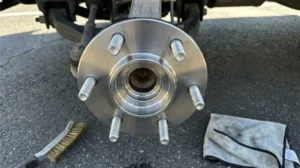
Long-Term Prevention Guide for Healthy F150 Wheel Hubs and Studs
Maintaining reliable wheel hubs and rust-free lug nuts on your Ford F150 requires a proactive post-install, seasonal, and annual routine. Re-checking torque after wheel service, upgrading to solid one-piece lug nuts, and cleaning hub faces prevent roadside emergencies. Follow this simple maintenance schedule to protect your truck wheels year-round.
Immediate Post-Install Routine (50 to 100 Miles / 80 to 160 km)
Whenever you remove a wheel or have new tires mounted, re-check your 2015 f150 lug nut torque after driving 50 to 100 miles (80 to 160 km).
- Aluminum wheels expand and contract during your first few highway heat cycles, which can settle tiny microscopic high spots on the mounting pad.
- Set your torque wrench to 150 ft lbs (204 Nm) and check each nut in a star pattern without loosening them first.
- Verify your average psi for a truck tire at the same time to ensure all four corners carry balanced air pressure.
Every Tire Rotation (Every 5,000 to 7,500 Miles / 8,000 to 12,000 km)
- Inspect all 24 lug nuts for early signs of cap bulging by sliding a standard 21 mm six-point socket over each nut by hand.
- If the 21 mm socket requires tapping with a mallet to fit, replace all 24 two-piece factory nuts with solid one-piece forged steel lug nuts immediately.
- Scrub the flat metal face of the brake rotor hat and the 87.1 mm center hub lip with a wire brush to remove surface rust.
- Apply a paper-thin film of high-temperature nickel or copper anti-seize only to the 87.1 mm center hub bore lip (never on the stud threads) so the aluminum wheel rim never corrodes onto the hub.
- If your dashboard tire light illuminates after rotating the wheels, follow our check tpms guide to relearn the sensor positions.
Annual Torque Tool & Spare Kit Readiness Check
- Have your click-type torque wrench tested or calibrated once a year if you perform regular maintenance on multiple vehicles.
- Place a 24 inch (60 cm) 1/2 inch breaker bar along with both a 21 mm and a 22 mm deep six-point socket under your F150 rear seat.
- The short L-shaped factory tire iron included behind the F150 passenger seat is barely 14 inches (35 cm) long, making it extremely difficult to break 150 ft lbs (204 Nm) of torque loose on the roadside.
Before you start
Tick these off as you gather them — nothing here is specialised.
0 of 8 ready · Ticks are for this visit only and aren't saved.
Common questions
What is the lug nut torque on a 2015 Ford F150?
The official 2015 f150 lug nut torque specification is 150 ft lbs (204 Nm). This torque setting applies to all 2015 Ford F150 cab styles, bed lengths, and engine configurations equipped with factory 17 inch, 18 inch, 20 inch, or 22 inch wheels. Always tighten the six lug nuts in a crisscross star pattern on clean, dry threads.
Did Ford F150 lug nut thread pitch change in 2015?
Yes, Ford changed the F150 wheel stud thread pitch starting with the 2015 model year. Trucks built from 2004 through 2014 use a coarse M14 x 2.0 thread pitch, while 2015 through 2026 models use a finer M14 x 1.5 thread pitch. Never mix lug nuts between 2014 and 2015 models, as the mismatched threads will strip immediately.
What size socket fits a 2015 to 2020 Ford F150 lug nut?
A standard undamaged factory lug nut on a 2015 to 2020 Ford F150 requires a 21 mm (13/16 inch) deep six-point socket. However, if the factory two-piece chrome cap has swollen from moisture and corrosion beneath the shell, you will need a 21.5 mm half-size socket or a 22 mm (7/8 inch) socket to remove it.
Why do Ford F150 lug nuts swell and jam in the socket?
Factory Ford F150 lug nuts use a two-piece design consisting of a steel inner core wrapped in a thin decorative chrome or stainless steel cap. Water and road salt seep between the two layers, causing the inner steel nut to rust and expand outward. Repeated use of impact wrenches also distorts the thin outer shell.
Should I torque aftermarket Gorilla lug nuts to 95 ft lbs or 150 ft lbs on an F150?
You should torque aftermarket one-piece Gorilla or McGard lug nuts to the Ford OEM specification of 150 ft lbs (204 Nm) on a 2004 to 2026 F150. The 95 ft lbs number printed on generic aftermarket packaging is a default passenger-car guideline used only when a vehicle manufacturer does not publish an official torque spec.
What is the lug nut torque for a 2011 to 2014 Ford F150?
The lug nut torque specification for a 2011, 2012, 2013, and 2014 Ford F150 is 150 ft lbs (204 Nm). Even though twelfth-generation F150 trucks (2009 to 2014) use coarse M14 x 2.0 wheel studs instead of the newer M14 x 1.5 studs, the required clamping torque remains identical at 150 ft lbs (204 Nm).
What is the correct tightening sequence for 6 lug F150 wheels?
For a 6-lug Ford F150 wheel, tighten the lug nuts in a crisscross star sequence rather than moving in a circle. Start at the top lug nut (position 1), move straight across to the bottom nut (position 4), then tighten top-right (2), bottom-left (5), bottom-right (3), and finally top-left (6) to seat the rim evenly.
Can you use an impact wrench to tighten Ford F150 lug nuts?
No, you should never use a pneumatic or cordless impact wrench for final tightening of Ford F150 lug nuts. Impact wrenches easily exceed 150 ft lbs (204 Nm), which stretches or snaps the wheel studs, warps brake rotors, and crushes the two-piece chrome lug caps. Always finish tightening by hand with a calibrated torque wrench.
When should you re-torque Ford F150 lug nuts after changing a tire?
You should re-torque your Ford F150 lug nuts to 150 ft lbs (204 Nm) after driving 50 to 100 miles (80 to 160 km) following any wheel removal or tire rotation. Initial driving heat cycles and road loads can cause aluminum alloy wheels to settle slightly against the hub face, which can reduce initial stud tension.
Does a Ford F150 Raptor have a different lug nut torque spec?
No, the main six wheel lug nuts on a Ford F150 Raptor (all generations from 2010 through 2026) use the exact same 150 ft lbs (204 Nm) torque specification as standard F150 models. Only the smaller decorative or functional outer beadlock ring bolts use a lower multi-pass torque sequence ending at 48 ft lbs (65 Nm).
Was this article useful?